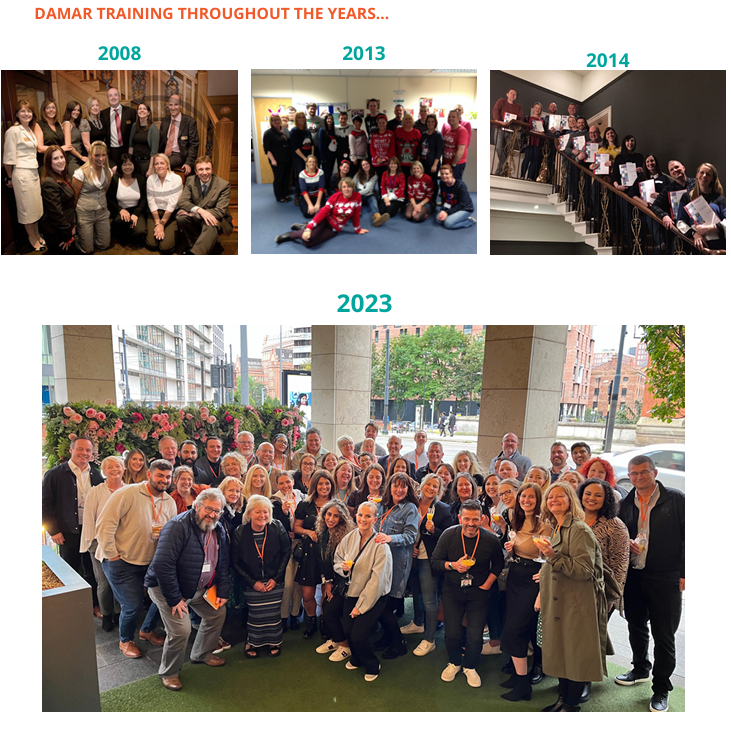















GMLPN has been an integral part of my and Damar’s journey since we bought the business from its founder in May 2006. I remember meeting Mark Currie (already GMLPN chair), bemused about the sector and what I had taken on. Since then, he and others in the network have been a constant source of guidance and support.
The Greater Manchester skills landscape in 2006 was very different. Apprenticeships were largely a cottage industry, with small independent providers serving local and often niche markets. In Stockport, where Damar was then based, providers specialised in areas such as veterinary care, engineering, hospitality and business, while the local FE college offered a broader range. Apprentices were typically aged 16–24. Most employers were local SMEs or public sector organisations.
Pastoral support was strong and apprenticeships provided a valuable route into employment. However, most programmes offered little structured training and apprenticeships lacked the status of academic routes. Progression to higher-level qualifications was difficult. There was a glass ceiling, even for the most able.
Funding was limited. Some apprenticeships attracted less than £1,000, forcing providers to operate on a shoestring and making it hard to attract talent. Regulation, led locally, often felt disconnected from delivery reality. I got excited when the Learning and Skills Council allocated us 10 of apprenticeships in business administration and accountancy for a Cheshire market town. It turned out there was no employer demand. Cue me, knocking on doors across office parks and industrial estates near Winsford.
Policy and regulation shifted frequently. At times overly restrictive, at others too loose – such as with Train to Gain. This inconsistency led to inefficiencies and, inevitably, concerns about the use of public funds.
The mid-2010s brought major reform. Apprenticeship standards and the introduction of the Levy transformed the sector, largely for the better. End-point assessment introduced rigour, and apprenticeships became focused on training to address clearly defined skills gaps. They expanded across all ages and levels, including professions such as law and architecture. In theory, the glass ceiling disappeared.
At Damar, this enabled us to create meaningful progression pathways for accountants, lawyers and managers, including opportunities for older workers who had previously missed out. Providers invested in people, technology and quality delivery, and strong partnerships emerged between employers, providers and professional bodies.
However, some challenges accompanied this progress. While large employers became more engaged, many smaller businesses disengaged. Some apprenticeship standards were overly narrow or complex, limiting their practicality and uptake. In striving for perfection, employer groups sometimes over-engineered programmes, making them harder to deliver.
Fewer of the new apprenticeships were suitable for young people – particularly those not in education, employment or training – while more programmes were designed for experienced workers. Predictably, this led to a rise in older learners and recent policy responses, such as age limits and the defunding of certain programmes. For some employers, Levy funding replaced existing training budgets. Meanwhile, demand for degree apprenticeships has far outstripped supply, with places often going to the most advantaged candidates.
Although the core principles of apprenticeship eligibility remain simple – a defined and significant skills gap; a relevant standard and employer commitment to all the study happening during contracted working hours – the funding rules are almost indecipherable to most. Limited oversight of provider growth, their balance sheets and how employers use apprenticeships has increased system risk. At the same time, basic questions are sometimes overlooked. Does the apprenticeship align with the job role? Is all the study taking place within working hours? Is the minimum required training being delivered? If not, it is not an apprenticeship.
Addressing these challenges requires collaboration between providers, employers and government, both locally and nationally. GMLPN has a vital role to play in bringing these partners together. We have clear, shared priorities: reducing NEET figures, supporting ambitious individuals, developing skills and driving economic growth.
Apprenticeships can deliver on these goals, particularly when aligned with initiatives such as the MBacc in Greater Manchester, Foundation Apprenticeships and higher education. They can create strong pipelines for early talent, progression and long-term development. But this depends on policymakers listening, engaging meaningfully and learning from past successes and failures.
Twenty years on, I am less bemused by the skills system and I believe more than ever in the power of apprenticeships. As CEO of Damar, a key part of my role is to advocate for a system that unlocks the potential of those who stand to benefit most. I look forward to continuing this work with GMLPN.