Ofsted: What have we learned in the first 6 months of the new regime?
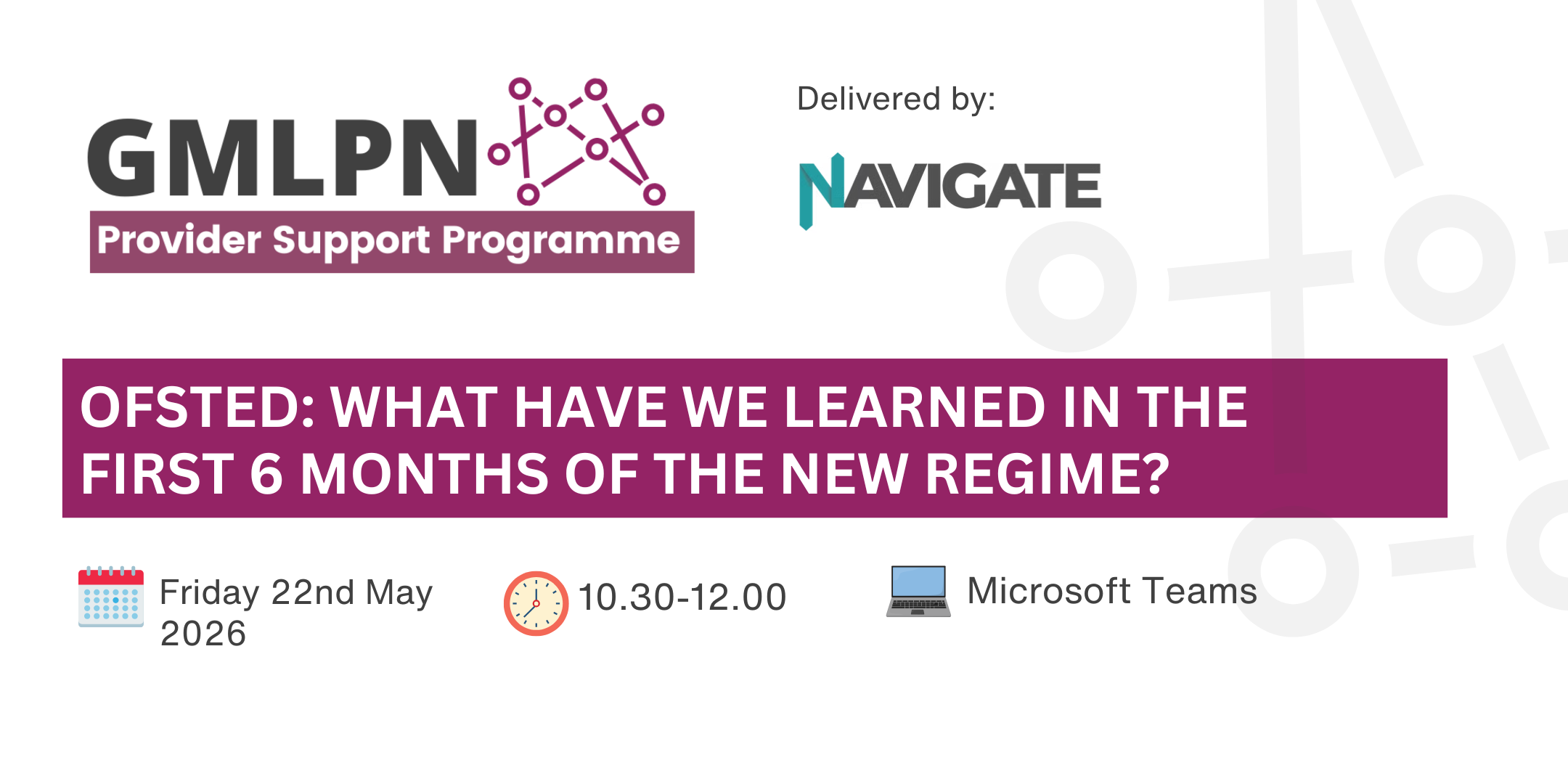
A practical session unpacking the new Ofsted Report Card framework and how data can evidence real learner impact.
To book, email: info@gmlpn.co.uk
- The session will be delivered by the team from Navigate:
- Chris Rowe, MD
This is a significant moment for the sector. As of May 2026, we’ve had six months of the “Report Card” era (which went live in November 2025) and the shift away from single-word judgements. The new “Secure Fit” model and the focus on Inclusion and Personal Development as standalone heavyweights align perfectly with the Navigate mission of evidence-based, high-impact learner journeys.
1. The New Landscape: From ‘Snapshot’ to ‘Report Card’
We will briefly explain the November 2025 transition. We’ve moved from reductive single-word grades to a 5-point scale (Exceptional to Urgent Improvement). We will discuss how this shift demands a more nuanced narrative in the Self-Assessment Report (SAR).
2. Personal Development: Beyond the ‘Bolt-On’
Recent reports show inspectors are looking for “intentionality.” It’s no longer enough to have a tutorial schedule; you must demonstrate how Personal Development is woven into the vocational curriculum.
Navigate Focus: How our platform tracks the impact of these interventions, not just the attendance.
3. The ‘Inclusion’ Deep Dive: A Standalone Priority
Inclusion is now a core area of evaluation. Inspectors are checking if the most vulnerable learners are making progress comparable to their peers. This is the “citadel of childhood/young adulthood” philosophy—if it works for the vulnerable, it works for everyone.
Navigate focus: EHCP assessment and achievement data.
4. Addressing Vulnerability: The ‘Fluid’ Definition
Ofsted now views vulnerability as fluid, not a fixed label. A learner might become vulnerable due to external factors (cost of living, mental health).
Navigate Focus: Using real-time data to identify shifts in engagement before they become “At Risk” statistics.
5. Work & Industry Experience: The Quality vs. Quantity Pivot
Data from the first 6 months shows Ofsted is critical of “meaningless” placements. They want to see how work experience aligns with a learner’s specific career aspirations and their “starting point.”
Navigate focus: Using a variety of data sources as evidence that placements have a meaningful impact.
6. The ‘Secure Fit’ Challenge: Meeting Every Standard
Under the new “Secure Fit” model, providers must meet every standard within a grade to achieve it. We’ll look at why many providers are hitting “Expected Standard” but struggling to reach “Strong” or “Exceptional” in the new toolkit.
Navigate focus: Surfacing ‘hidden’ and stretch areas of excellence.
7. British Values & SMSC in a Modern Context
Inspectors are moving away from “poster on the wall” British Values. They are looking for how learners handle “Ordinary Tuesday” challenges—online radicalisation, toxic masculinity (the ‘Manosphere’), and respectful debate in the classroom.
Navigate focus: How the AI Reflection Coach embeds knowledge and impact.
8. Employer Engagement: More Than Just a Reference
Reports are highlighting the need for employers to be involved in curriculum design, not just end-of-course sign off or placements. We’ll discuss how to evidence this collaborative relationship.
Navigate focus: Using CRM data to effectively engage employers, grow the relationship and track engagement.
9. Safeguarding: The Binary ‘Met’ or ‘Not Met’
Safeguarding remains a separate, high-stakes judgement. We’ll cover the first 6 months’ trends in “Culture of Vigilance”—specifically how providers are managing early drop out, digital safety and the rise of AI-generated risks.
Navigate Focus: Using Wellbeing assessment data to identify and at-risk learners
10. Data with a Soul: Telling the Learner’s Story
The new Report Cards include “Contextual Data.” We’ll discuss how to use tools like Navigate to provide the narrative behind your data—explaining why certain cohorts face barriers and how you are systematically removing them.
Navigate focus: Triangulating data to fully understand how a learner is making progress beyond ‘just’ grades.
11. Student Voice: The ‘Qualitative’ King
Inspectors are spending more time talking to learners and less time in the “data room.” We’ll explore how to ensure your learners can articulate their own progress in Personal Development and Work Experience.
Navigate Focus: Navigate culminates in a Digital CV and is a legacy takeaway for the student. It also helps the student contextualise and value all the small elements they do in their journey that creates the ‘end product’.
12. Preparing for the Next 6 Months: Your Action Plan
Closing the session with a summary of the “must-haves” for 2026. This includes tightening the link between industry experience and the “Personal Development and Wellbeing” grade.
- Jude Flatley, Head of Customer Success and T Level Expert
- Beth Robinson, Manchester Region Account Manager and L6 Careers Lead